
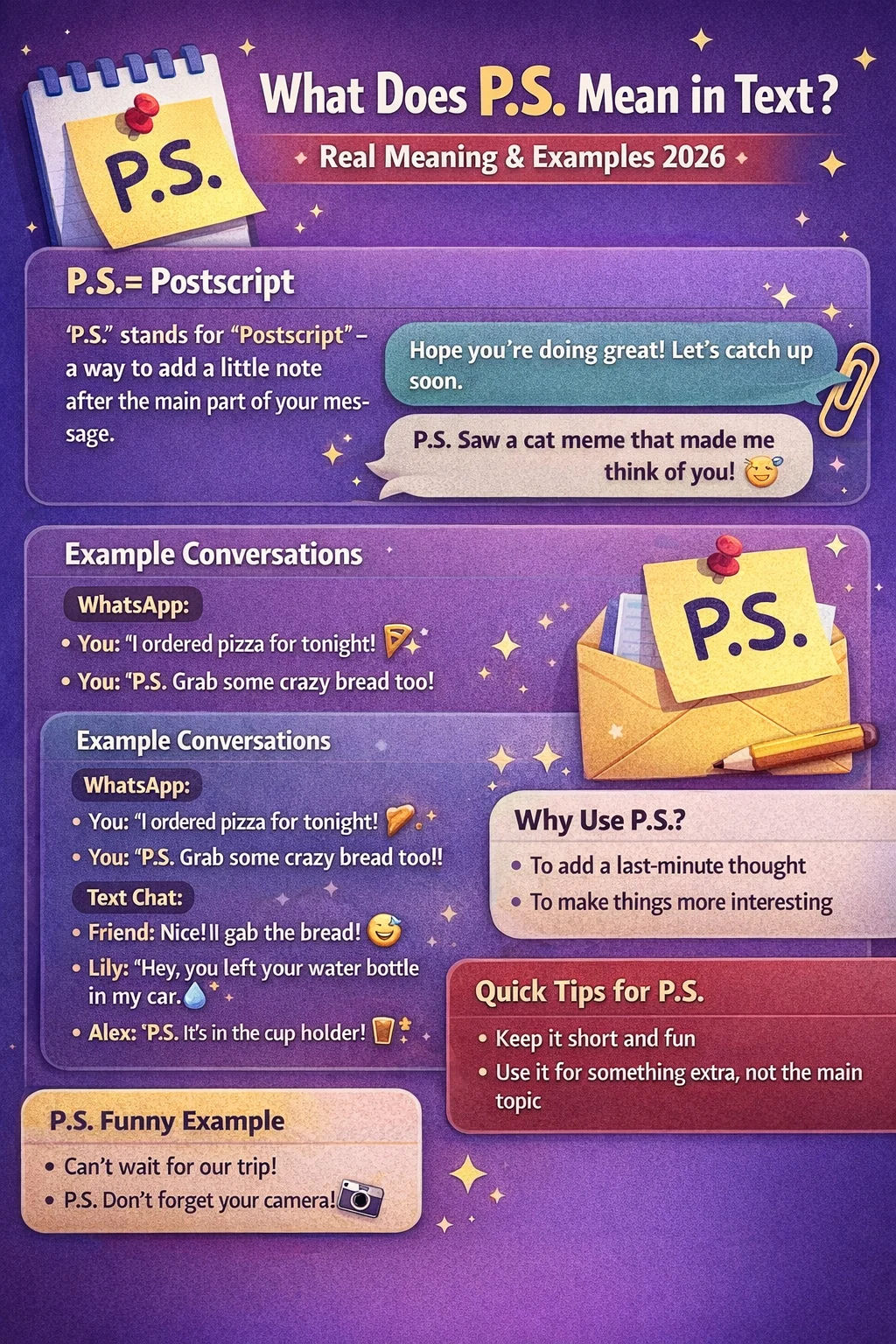
You’ve probably seen “P.S.” at the end of a message, email, or even a handwritten note and thought, what does that actually mean?
It looks small. Almost unimportant. But surprisingly, those two letters can carry a lot of meaning—sometimes even more than the main message itself.
Whether you’re texting a friend, writing an email, or posting online, understanding what P.S. means in text can help you sound more natural, expressive, and even a little more memorable.
Let’s break it down in a simple, real-world way.
What Does P.S. Mean?
P.S. stands for “postscript.”
It comes from Latin:
- “post” = after
- “scriptum” = written
So, P.S. literally means “written after.”
👉 In simple terms:
It’s something you add after you’ve already finished your main message.
Why Do People Use P.S.?
Originally, P.S. was used in handwritten letters. People would finish writing, then suddenly remember something important—and instead of rewriting everything, they’d just add a P.S. at the end.
Today, even though editing is easy, people still use P.S. because it feels:
- Personal
- Attention-grabbing
- Slightly emotional or informal
Sometimes, the P.S. is actually the most important part.
P.S. Meaning in Text Messages
In texting, P.S. is used to add an extra thought, feeling, or reminder after the main message.
Example:
I’ll send you the file tonight.
P.S. Don’t forget our meeting tomorrow!
Here, the P.S. adds a reminder without interrupting the main message.
P.S. in Social Media
On platforms like Instagram, Facebook, or even WhatsApp, people use P.S. to:
- Add humor
- Share a secret
- Emphasize something important
Example:
Finally finished my project 😅
P.S. I survived on coffee alone.
It gives your message a more human and relatable touch.
Emotional Meaning Behind P.S.
This is where things get interesting.
P.S. often carries a more emotional or personal tone than the main message.
Why?
Because it feels like an afterthought—something you almost didn’t say, but decided to share anyway.
For example:
Good night.
P.S. I miss you.
That P.S. changes everything. It adds depth, emotion, and honesty.
P.S. in Emails (Professional Use)
In emails, P.S. is still widely used—but more strategically.
Marketers and professionals use it to:
- Highlight important information
- Add a call to action
- Reinforce a message
Example:
Looking forward to your response.
P.S. The deadline is Friday.
It draws attention because people often scan emails—and the P.S. stands out.
Common Variations You Should Know
Once you understand P.S., you’ll start noticing these too:
- P.P.S. → Post-postscript (something added after the P.S.)
- P.P.P.S. → Yes, it exists (but rarely used)
Example:
Thanks for your help!
P.S. You’re amazing.
P.P.S. Coffee on me next time ☕
When Should You Use P.S.?
You can use P.S. when you want to:
- Add a forgotten detail
- Say something emotional
- Make your message feel personal
- Highlight something important
But avoid using it when:
- Writing very formal documents
- Creating academic or official reports
- It feels unnecessary or forced
Real-Life Examples of P.S. in Text
1. Friendly Message
See you later!
P.S. Bring snacks 😄
2. Romantic Message
Goodnight ❤️
P.S. You made my day.
3. Casual Reminder
I sent the link.
P.S. Check your spam folder too.
4. Funny Use
I’m starting a diet tomorrow 😂
P.S. This time I mean it.
Why P.S. Still Matters Today
Even in a world of instant editing and typing, P.S. hasn’t disappeared.
That’s because it adds something technology can’t replace:
👉 A human touch
It feels spontaneous. Honest. Real.
It breaks the “perfect” structure of a message—and that’s exactly why people like it.
Personal Insight (Real-Life Feel)
I remember getting a simple message once:
Take care.
P.S. Don’t overwork yourself.
That one line stayed with me more than the entire message.
Why?
Because it felt genuine. Like the person paused, thought about me, and added something meaningful.
That’s the power of P.S.—it turns ordinary messages into memorable ones.
Common Mistakes to Avoid
Here are a few things people often get wrong:
1. Using it too often
If every message has a P.S., it loses its impact.
2. Adding irrelevant information
Keep it meaningful or interesting.
3. Overloading with multiple P.S.
One is enough in most cases.
Is P.S. Formal or Informal?
It depends on how you use it.
- Formal writing: Rarely used
- Emails: Acceptable and often effective
- Texts & social media: Very common
It sits somewhere between formal and casual—but leans more toward personal communication.
Quick Summary (Featured Snippet Style)
P.S. means “postscript,” which refers to an extra message added after the main text. It’s commonly used in emails, texts, and social media to add reminders, emotions, or additional thoughts.
FAQs
1. What does P.S. stand for in texting?
It stands for “postscript,” meaning something added after the main message.
2. Is P.S. still used today?
Yes, especially in texts, emails, and social media for emphasis or personal touch.
3. Can I use P.S. in professional emails?
Yes, but use it carefully—mainly for highlighting key points.
4. What is P.P.S.?
It means “post-postscript,” an extra note after the P.S.
5. Is P.S. formal or informal?
It’s mostly informal but acceptable in semi-professional communication.
Final Thoughts
P.S. may look small, but it carries a unique kind of power.
It’s where people:
- Add emotion
- Share something honest
- Or say what they really feel
In a world full of quick messages, P.S. reminds us that sometimes, the last words matter the most.
descover more post
What Does XD Mean in Text Real Meaning Examples 2026
What Does WTH Mean in Text Real Meaning Examples 2026
What Does LMAO Mean in Text Real Meaning Examples 2026

M. Kiro is a passionate writer who enjoys turning everyday questions into clear and meaningful answers. He focuses on creating helpful, honest, and easy-to-read content for people who just want simple explanations without confusion. His work reflects consistency, hard work, and a deep commitment to helping readers understand things better.