
You’ve probably seen “FYI” pop up in a message, email, or even a comment and wondered what it actually means. It looks short, casual, and a bit “office-style,” but people use it everywhere now—from work chats to Instagram captions.
The interesting part is that most people use it without thinking twice. But if you’re new to internet slang or just want to understand it clearly, FYI is actually more useful than it looks.
In this guide, we’ll break down what FYI means, how people use it in real life, when it sounds professional, when it sounds casual, and how you can use it naturally without sounding awkward.
What Does FYI Mean in Text?
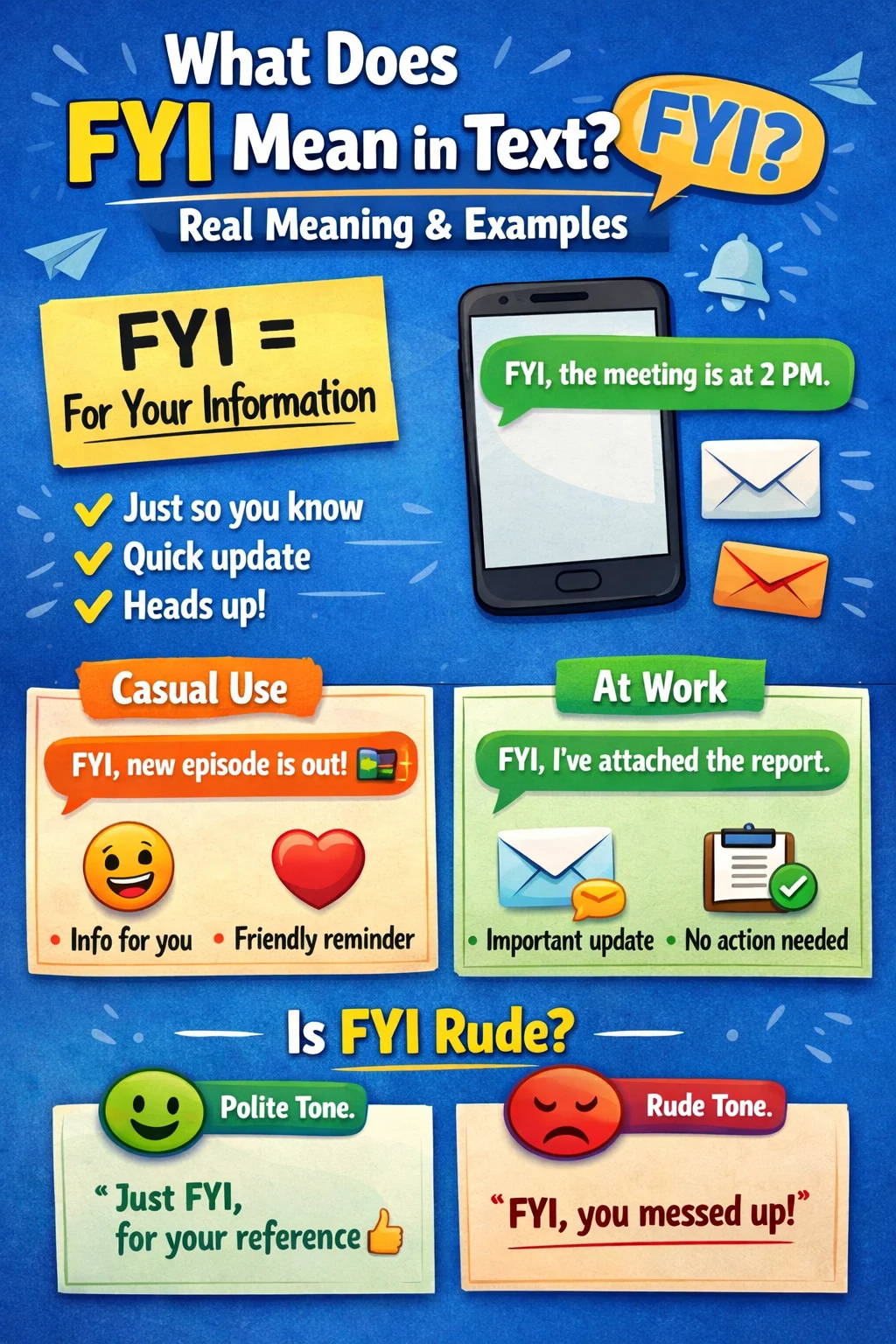
FYI stands for “For Your Information.”
It’s used when someone wants to share information with you that might be useful, relevant, or worth knowing—but not necessarily something you need to respond to.
In simple words:
👉 FYI = “Just so you know”
👉 FYI = “Here’s something important/informative”
👉 FYI = “I’m telling you this for awareness”
Example:
- “FYI, the meeting is moved to 3 PM.”
No reply is always required. It’s more about sharing information than starting a conversation.
The Real Purpose of FYI in Communication
FYI is not just slang—it’s a communication shortcut.
People use it to:
- Share updates quickly
- Avoid long explanations
- Make messages sound neutral
- Reduce back-and-forth replies
It helps in both formal and informal communication because it keeps things efficient.
Think of it as a “soft notification.” It tells you something without demanding action.
FYI in Everyday Texting
In texting, FYI has become very casual. Friends use it all the time, often in slightly different tones depending on the situation.
Examples in casual chats:
- “FYI I already ate, don’t wait for me 😅”
- “FYI your favorite show released a new season”
- “FYI that place you mentioned is closed today”
In this context, FYI feels more like:
👉 “Just letting you know”
It’s friendly, light, and often used when someone shares random updates.
FYI in Emails and Work Communication
FYI is extremely common in professional settings like emails, Slack, or business chats.
Example:
- “FYI, I’ve attached the updated report.”
In work communication, FYI usually means:
- This is useful information
- No immediate action is required
- I’m keeping you informed
But tone matters.
In professional emails, FYI can sometimes feel slightly blunt if overused. That’s why people often pair it with polite wording:
Better version:
- “Just FYI, I’ve attached the updated report for your reference.”
This sounds smoother and more professional.
Different Ways FYI Is Used (Context Matters)
Even though FYI has one meaning, the tone changes depending on context.
1. Neutral Information Sharing
- “FYI, the store opens at 10 AM.”
2. Friendly Reminder
- “FYI, don’t forget your appointment.”
3. Slightly Serious Tone
- “FYI, this issue has already been reported.”
4. Passive Warning (careful tone)
- “FYI, that shortcut isn’t safe at night.”
So even though it looks simple, FYI can carry different emotional weight depending on how it’s used.
Is FYI Rude or Polite?
This is where things get interesting.
FYI is not automatically rude—but it can sound rude if the tone feels sharp or unnecessary.
It feels polite when:
- Used casually or professionally
- Followed by helpful context
- Written in a friendly tone
It feels rude when:
- It replaces a full explanation
- It sounds dismissive
- It is used in arguments like “FYI, you’re wrong”
Example of rude tone:
- “FYI, you didn’t read the instructions.”
Same phrase, better tone:
- “Just FYI, the instructions mention a different process.”
So it’s not the word—it’s the delivery.
FYI on Social Media
On platforms like Instagram, X (Twitter), or TikTok comments, FYI is often used in a more expressive or dramatic way.
Examples:
- “FYI this is the best pizza I’ve ever had 🍕”
- “FYI this trend is getting out of control”
- “FYI nobody asked but here’s my opinion 😂”
On social media, FYI is less formal and more personality-driven. People use it for humor, sarcasm, or emphasis.
Common Mistakes People Make with FYI
Even though FYI is simple, people sometimes misuse it.
1. Using it when a response is required
If you need action, FYI alone is not enough.
Bad:
- “FYI, fix this issue.”
Better:
- “Please fix this issue by 5 PM.”
2. Overusing FYI in emails
Too many FYIs can make communication sound robotic or passive.
3. Using it in emotional conversations
FYI can feel cold in sensitive discussions.
Instead of:
- “FYI, I don’t agree with you.”
Try:
- “I see your point, but I see it differently.”
Alternatives to FYI
If you want to sound more natural or varied, here are some alternatives:
- “Just so you know”
- “For your reference”
- “I wanted to let you know”
- “Heads up”
- “Quick update”
- “In case you missed it”
Each one fits slightly different tones depending on how formal or friendly you want to be.
Why People Use FYI So Much Today
FYI has become popular because modern communication is fast.
People don’t want long explanations for everything. So instead of writing a paragraph, they just say:
👉 FYI + information
It saves time, keeps messages clean, and works across both casual and professional settings.
It’s basically a product of digital speed culture.
Real-Life Examples of FYI
Let’s make it more practical.
Example 1: Workplace
“FYI, the client call is rescheduled to Thursday.”
Example 2: Friend chat
“FYI your order is finally here 😂”
Example 3: Family message
“FYI I’ll be late for dinner today.”
Example 4: Social media comment
“FYI this song hits different at night.”
Each example shows how flexible the phrase really is.
Psychological Side of FYI
Interestingly, FYI also has a subtle psychological function.
It creates:
- A sense of distance (less pressure)
- A feeling of neutrality
- A “no obligation” message tone
That’s why people use it when they don’t want to sound demanding or emotional.
It’s like saying:
👉 “Here’s the info… do what you want with it.”
When You Should Avoid FYI
Even though it’s useful, FYI is not always the best choice.
Avoid it when:
- You need urgent action
- The situation is emotional
- You want to sound warm and personal
- You are giving instructions
In those cases, full sentences work better than shortcuts.
FAQs
1. What does FYI stand for in text?
FYI means “For Your Information.”
2. Is FYI formal or informal?
It can be both, depending on context. It’s common in emails and casual chats.
3. Is FYI rude?
Not by itself. Tone and context decide whether it feels polite or rude.
4. Can I use FYI in emails?
Yes, especially for sharing updates, but don’t overuse it.
5. What can I say instead of FYI?
You can say “just so you know,” “heads up,” or “for your reference.”
Final Thoughts
FYI may look like a small internet abbreviation, but it plays a big role in modern communication.
It helps people share information quickly, keep conversations simple, and avoid unnecessary explanations. But like any communication tool, it works best when used with awareness of tone and context.
At the end of the day, FYI is just another way of saying:
👉 “Here’s something you should know.”
Simple, useful, and everywhere.
descover more post
What Does what does bsfs mean in Text Real … – Meanliab.com
What Does igl Meaning Slang Mean in Text Real Meaning 2026
What Does WTB Mean in Text Real Meaning Examples 2026

M. Kiro is a passionate writer who enjoys turning everyday questions into clear and meaningful answers. He focuses on creating helpful, honest, and easy-to-read content for people who just want simple explanations without confusion. His work reflects consistency, hard work, and a deep commitment to helping readers understand things better.