
You’re scrolling through your messages, and suddenly you see someone write: “FYI, the meeting is at 3 PM.”
You pause for a second.
What does FYI actually mean? Is it formal? Is it rude? Or just a simple heads-up?
If you’ve ever felt unsure about using or understanding this common abbreviation, you’re not alone. “FYI” shows up everywhere—from casual chats to professional emails—and knowing how to use it correctly can save you from awkward misunderstandings.
Let’s break it down in a simple, human way.
What Does FYI Mean?
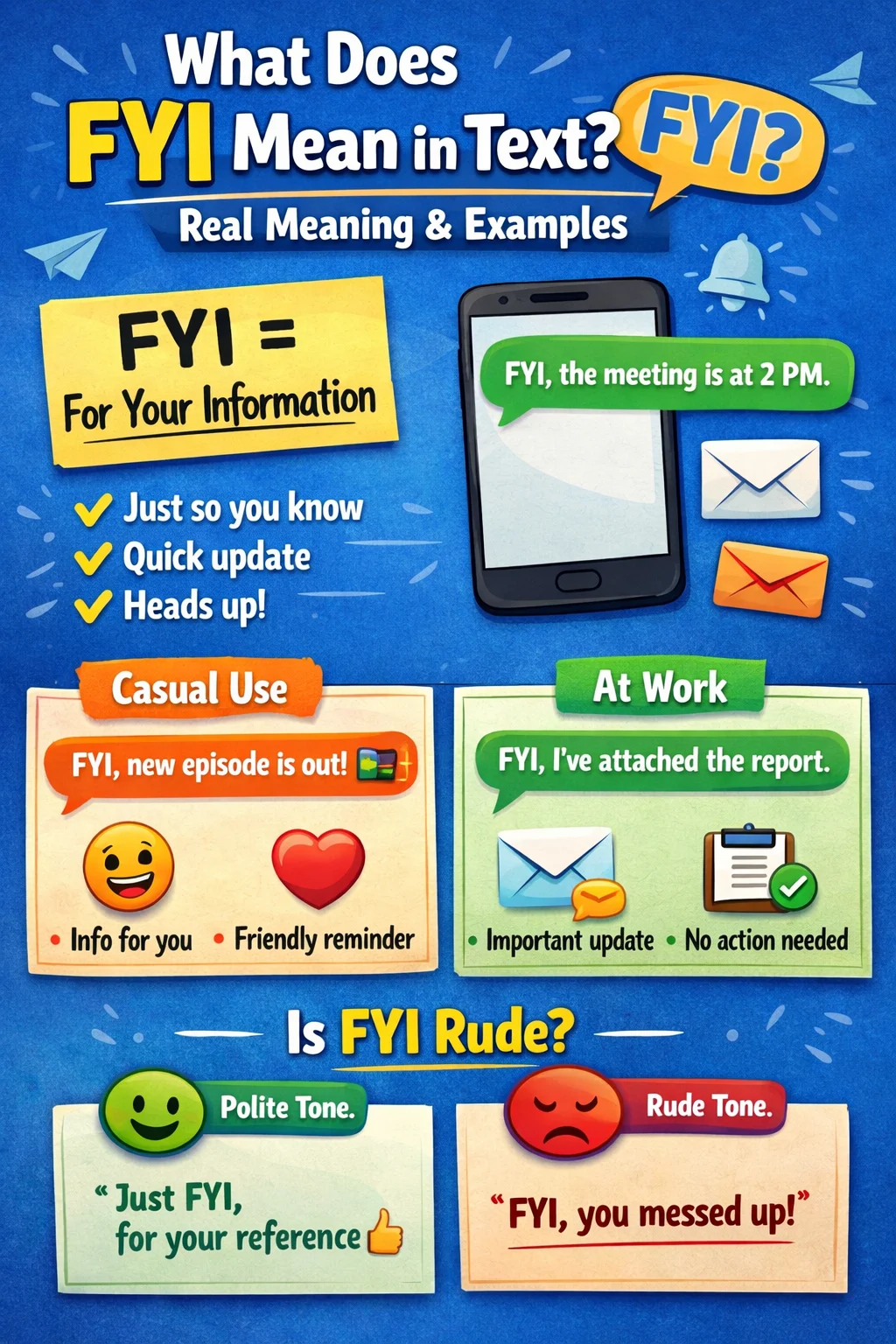
FYI stands for “For Your Information.”
It’s used when someone wants to share information with you—without expecting a reply or action.
Think of it like saying:
👉 “Just so you know”
👉 “Here’s something you might find useful”
Quick Example:
- “FYI, the store closes early today.”
- “FYI, I already sent the email.”
In both cases, the person is simply informing—not asking.
Why Do People Use FYI?
People use FYI because it’s:
- Quick and efficient
- Neutral in tone
- Widely understood
It saves time, especially in texting or work communication.
Instead of writing:
“I just wanted to let you know that…”
You can simply write:
“FYI…”
Short, simple, and clear.
Is FYI Formal or Informal?
This is where things get interesting.
FYI can be both formal and informal, depending on how you use it.
In Professional Settings:
It’s often used in emails to share updates or documents.
Example:
- “FYI, I’ve attached the report for your review.”
In Casual Conversations:
It’s more relaxed and friendly.
Example:
- “FYI, your favorite show just dropped a new episode.”
👉 Tone matters. Sometimes FYI can sound helpful—but other times, it can feel blunt if not used carefully.
Real-Life Examples of FYI
Let’s look at how people actually use it in everyday life.
In Text Messages:
- “FYI, I’ll be late today.”
- “FYI, I already told her.”
In Work Emails:
- “FYI, the deadline has been moved to Friday.”
- “FYI, the client approved the design.”
On Social Media:
- “FYI, this hack actually works!”
- “FYI, not everything online is true.”
When FYI Can Sound Rude
Here’s something many people don’t realize:
👉 FYI can sometimes come across as passive-aggressive.
It depends on context and tone.
Example:
- “FYI, this was already discussed.”
This might sound like:
“You should have known this.”
So while FYI itself isn’t rude, it can feel that way if used sharply or without context.
How to Make It Sound Polite:
Add a softener:
- “Just an FYI…”
- “Hey, FYI…”
This makes your message feel more friendly and less abrupt.
Variations and Similar Slang
If you want to sound more natural, here are some alternatives to FYI:
- Just so you know (JSYK)
- Heads up
- By the way (BTW)
- In case you didn’t know (ICYDK)
Each has a slightly different tone, but they all serve a similar purpose.
How to Use FYI Correctly
Using FYI is simple—but using it well is what makes the difference.
1. Use It for Sharing, Not Ordering
FYI is for information, not instructions.
✔️ Good:
- “FYI, the meeting link is updated.”
❌ Not ideal:
- “FYI, complete this task today.” (This sounds confusing)
2. Keep It Relevant
Only use FYI when the information matters to the person.
Don’t overload people with unnecessary updates.
3. Match the Tone
If you’re talking to a friend, keep it casual.
If you’re emailing a boss, keep it polite and clear.
FYI in Social Media Culture
On platforms like Instagram, Twitter, or TikTok, FYI is often used to:
- Share quick facts
- Drop opinions
- Add emphasis
Example:
- “FYI, this trend is not new.”
- “FYI, you don’t need expensive tools to start.”
It’s become part of everyday digital language.
Common Mistakes People Make
Let’s clear up a few things:
❌ Using FYI too often
It loses impact if you use it in every message.
❌ Sounding too blunt
Without context, it can feel cold.
❌ Using it in emotional conversations
FYI isn’t great for sensitive topics—it can feel detached.
Personal Insight (Real Talk)
There was a time I used FYI in almost every email I wrote.
At first, it felt professional. Clean. Efficient.
But then I noticed something.
A colleague once replied:
“Thanks… but your message sounded a bit sharp.”
That made me pause.
I realized something simple:
👉 Words are not just about meaning—they carry tone.
Since then, I still use FYI—but more thoughtfully. I add context, warmth, and sometimes skip it entirely when a more human phrase fits better.
Simple Rule to Remember
If you’re ever unsure, ask yourself:
👉 “Am I sharing information… or telling someone what to do?”
If it’s just information—FYI works perfectly.
FAQs
1. What does FYI mean in texting?
It means “For Your Information,” used to share something without expecting a reply.
2. Is FYI rude?
Not usually, but it can sound rude depending on tone and context.
3. Can I use FYI in professional emails?
Yes, it’s commonly used in workplaces to share updates or information.
4. What is the difference between FYI and BTW?
FYI shares important info, while BTW (by the way) adds casual or extra information.
5. What can I say instead of FYI?
You can use “just so you know,” “heads up,” or “by the way.”
Final Thoughts
“FYI” might be just three letters—but it carries a lot of meaning.
It’s simple, useful, and everywhere in modern communication.
But like any word, how you use it matters just as much as what it means.
When used thoughtfully, FYI becomes more than just shorthand—it becomes a smooth, respectful way to share information.
descover more post
What Does what does bsfs mean in Text Real … – Meanliab.com
What Does igl Meaning Slang Mean in Text Real Meaning 2026
What Does WTB Mean in Text Real Meaning Examples 2026

N. Vexa is a dedicated content writer who specializes in explaining words, meanings, and internet slang in the simplest way possible. With a strong focus on clarity and accuracy, N. Vexa creates content that helps readers quickly understand modern language without confusion. Known for a hardworking approach and attention to detail, the goal is always to make information easy, useful, and accessible for everyone.