
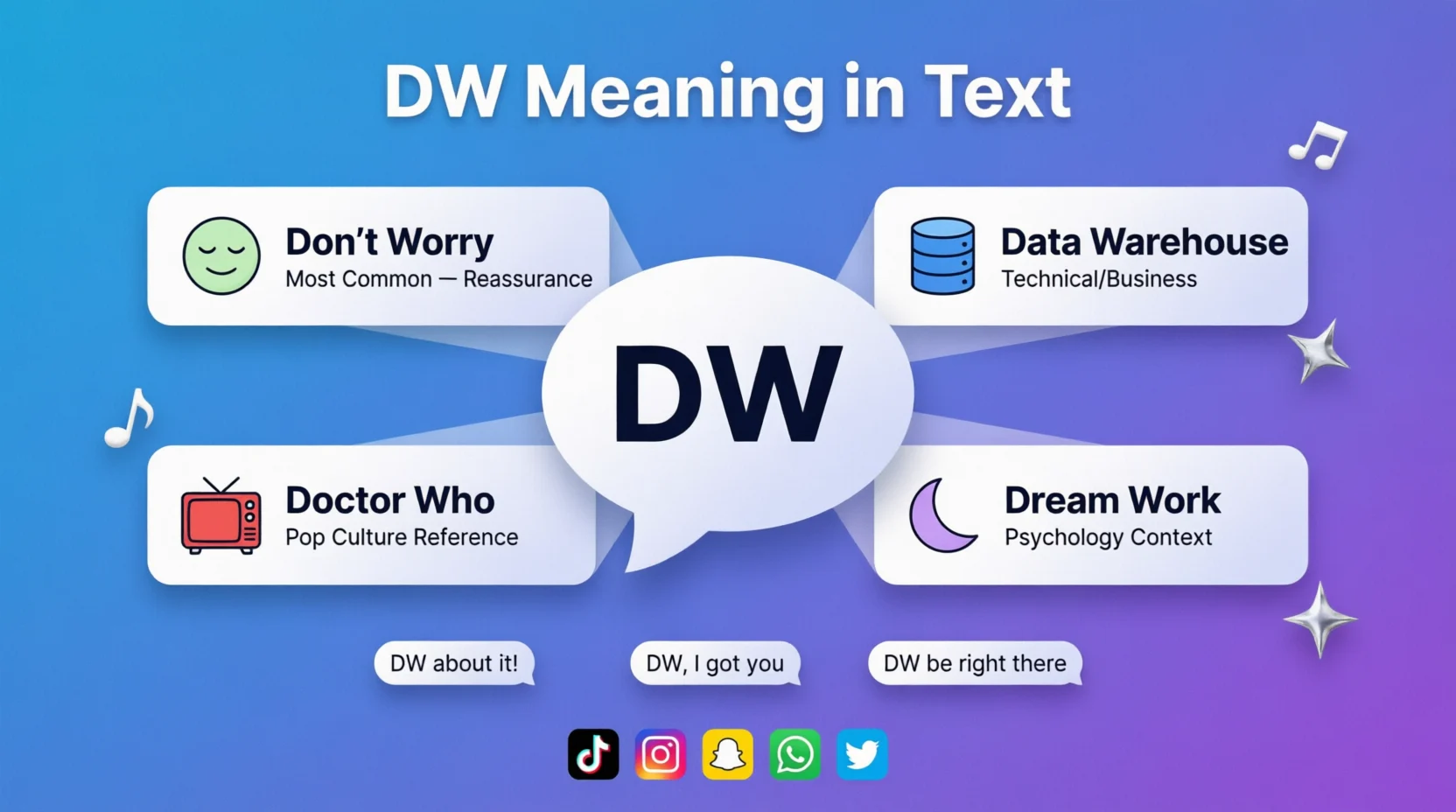
If you’ve ever received a message that simply says “DW” and wondered what it means, you’re not alone. Texting slang evolves quickly, and new abbreviations appear on social media, messaging apps, and online communities all the time.
Among the most common shorthand expressions used in conversations today is DW. You’ll see it in text messages, Snapchat chats, Instagram comments, TikTok captions, WhatsApp conversations, and even emails between friends.
But what does DW mean in text, and when should you use it?
In this guide, you’ll learn the real meaning of DW, how people use it in conversations, examples from social media, alternative meanings, and situations where it might be misunderstood.
What Does DW Mean in Text?
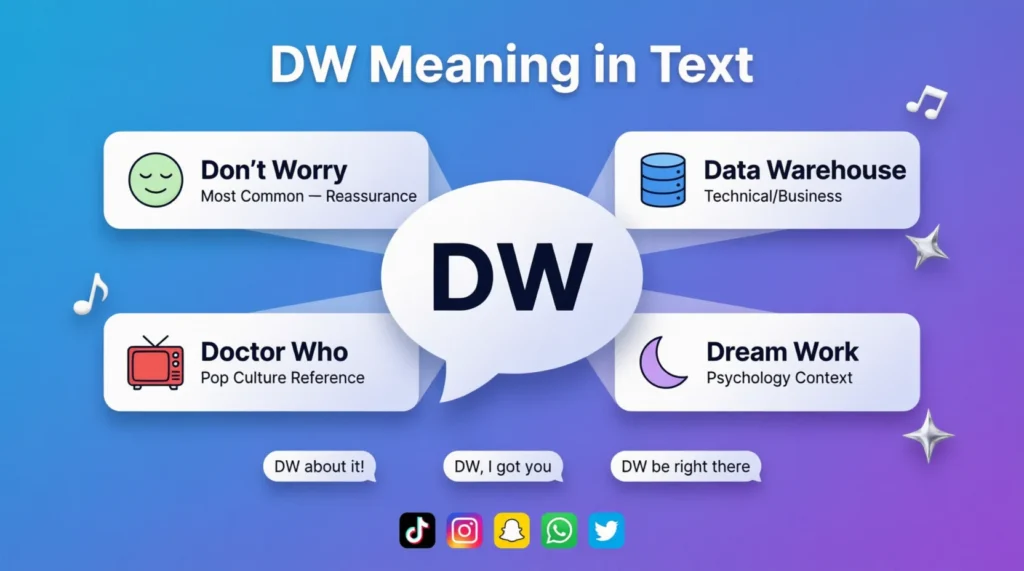
In most texting and social media conversations, DW means “Don’t Worry.”
People use it to reassure someone, reduce stress, or let another person know that a situation is okay.
It’s a quick and friendly way of saying:
- Don’t worry about it.
- It’s okay.
- No problem.
- Everything is fine.
- You don’t need to stress about it.
Because texting often favors short and fast communication, many people prefer typing “DW” instead of the full phrase “don’t worry.”
Example
Person 1: Sorry I’m running late.
Person 2: DW, take your time.
In this example, DW reassures the other person that being late is not a big issue.
The Simple Meaning of DW
The abbreviation DW is all about reassurance.
When someone uses it, they’re usually trying to make another person feel more comfortable or less concerned.
Think of DW as the digital version of saying:
“It’s okay.”
or
“No need to worry.”
The tone is generally friendly, casual, and supportive.
Where Did DW Come From?
Like many internet abbreviations, DW became popular as texting and instant messaging grew.
Early chat rooms, SMS messages, and online forums encouraged people to shorten common phrases because typing was slower and character limits existed.
Expressions such as:
- LOL
- BRB
- IDK
- IMO
- DW
became part of everyday online language.
Today, DW remains popular because it is easy to type and instantly understood by many internet users.
How DW Is Used in Text Messages
The most common use of DW is to comfort or reassure someone.
Example 1
Friend: I forgot to bring your book.
You: DW, you can give it to me tomorrow.
Example 2
Friend: Sorry for replying late.
You: DW, I was busy too.
Example 3
Friend: I think I made a mistake.
You: DW, we’ll figure it out.
In each example, DW reduces tension and helps the conversation stay positive.
What Does DW Mean on Social Media?
On platforms such as Instagram, TikTok, Snapchat, Facebook, and X, DW usually still means Don’t Worry.
People use it in comments, captions, direct messages, and replies.
Instagram Example
Comment: Sorry I missed your live stream.
Reply: DW, I’ll do another one soon.
TikTok Example
Comment: I can’t find this song.
Reply: DW, I’ll post the title in the comments.
Snapchat Example
Friend: I accidentally opened your snap and forgot to reply.
Reply: DW lol.
The meaning remains the same across most social platforms.
DW Meaning in Snapchat
Snapchat users frequently use abbreviations because conversations move quickly.
On Snapchat, DW almost always means:
Don’t Worry
Examples include:
- DW, it’s fine.
- DW about it.
- DW, I understand.
- DW, no problem.
Because Snapchat conversations are casual, DW fits naturally into everyday chats.
DW Meaning on TikTok
TikTok comments can move extremely fast, and users often shorten common phrases.
Examples:
User 1: Sorry if this question sounds dumb.
User 2: DW, ask anything.
Or:
User 1: I missed part 1.
User 2: DW, here’s the link.
Again, the purpose is reassurance.
DW Meaning on Instagram
Instagram users commonly use DW in:
- Direct messages
- Story replies
- Comments
- Group chats
For example:
Friend: Sorry I couldn’t make it.
You: DW, we’ll hang out another day.
The phrase helps maintain a relaxed and friendly tone.
Common Conversation Examples of DW
Here are several real-world examples showing how people use DW.
Example A
Alex: Sorry, I forgot to text back.
Jordan: DW, I understand.
Example B
Emma: I think I sent the wrong file.
Chris: DW, just resend it.
Example C
Mia: I’m nervous about tomorrow.
Lily: DW, you’ll do great.
Example D
Jake: Sorry for bothering you.
Ryan: DW, you’re not bothering me.
These examples show that DW is often associated with kindness and reassurance.
Different Ways People Write DW
Although DW is common, people also write the phrase in other forms.
Examples include:
- Don’t worry
- Dont worry
- Dw
- DW
- d/w (less common)
- Don’t stress
- No worries
- It’s okay
All communicate a similar message.
Is DW Formal or Informal?
DW is considered informal language.
It works best in:
- Text messages
- Social media chats
- Messaging apps
- Conversations with friends
- Casual online discussions
It is generally not appropriate for:
- Academic papers
- Professional reports
- Formal business communication
- Official documents
Instead of DW in formal writing, use:
- Don’t worry.
- No problem.
- There is no issue.
- Please don’t be concerned.
Formal Example
Instead of:
“DW, we’ll handle it.”
Write:
“Please don’t worry; we will handle it.”
When Should You Use DW?
DW is useful when you want to reassure someone quickly.
Good situations include:
When Someone Apologizes
Friend: Sorry I’m late.
You: DW.
When Someone Is Nervous
Friend: I’m worried about the interview.
You: DW, you’ll do well.
When Someone Makes a Small Mistake
Friend: I accidentally deleted the message.
You: DW, it’s fine.
When Someone Feels Guilty
Friend: Sorry I couldn’t help.
You: DW, I managed.
In each case, the abbreviation helps create a supportive conversation.
When You Should Avoid Using DW
Even though DW is useful, there are situations where it may not be appropriate.
Serious Situations
If someone is discussing a major problem, a simple DW may sound dismissive.
For example:
Friend: I lost my job today.
Responding with only:
“DW”
might feel insensitive.
A better response would be:
“I’m sorry you’re going through that. Let me know if I can help.”
Professional Communication
In workplace emails, spelling out your message is usually more professional.
Instead of:
“DW about the report.”
Use:
“Please don’t worry about the report. We’ll address it together.”
Alternative Meanings of DW
Although “Don’t Worry” is the most common meaning, DW can occasionally represent other phrases depending on context.
Dear Wife
Some people use DW to mean Dear Wife in family discussions or online forums.
Example:
“My DW planned the whole vacation.”
In this case, DW does not mean “Don’t Worry.”
Doctor Who
Fans of the TV show may use DW as a shorthand for the popular series:
Doctor Who
Example:
“I’m watching DW tonight.”
Disney World
Some travelers use DW when referring to:
Walt Disney World
Example:
“We’re going to DW next summer.”
However, in texting conversations between friends, “Don’t Worry” remains by far the most common meaning.
How to Know Which Meaning of DW Is Intended
Context is everything.
Consider the conversation.
Example 1
Friend: Sorry I’m late.
Reply: DW.
Meaning: Don’t Worry.
Example 2
“My DW loves gardening.”
Meaning: Dear Wife.
Example 3
“I started watching DW again.”
Meaning: Doctor Who.
Looking at the surrounding words usually makes the meaning obvious.
Why Is DW So Popular?
There are several reasons people continue using DW.
It Saves Time
Typing two letters is faster than typing “don’t worry.”
It Feels Friendly
DW sounds relaxed and supportive.
It Is Easy to Understand
Most frequent internet users recognize it instantly.
It Fits Modern Communication
People often prefer quick responses on mobile devices, making abbreviations convenient.
Similar Texting Abbreviations
If you’re learning internet slang, you may also encounter these common abbreviations.
LOL
Laugh Out Loud
BRB
Be Right Back
IDK
I Don’t Know
IMO
In My Opinion
TBH
To Be Honest
FYI
For Your Information
NVM
Never Mind
TTYL
Talk To You Later
Like DW, these abbreviations help make digital conversations faster.
DW vs No Worries
Both expressions communicate reassurance, but they feel slightly different.
DW
- Very short
- Common in texting
- Informal
- Often used among friends
No Worries
- Slightly more conversational
- Can be spoken or written
- Works in many casual situations
Examples:
DW, it’s okay.
No worries, it’s okay.
Both are acceptable in casual communication.
Frequently Asked Questions
What does DW mean in a text message?
DW usually means Don’t Worry. It is used to reassure someone that everything is okay.
What does DW mean on Snapchat?
On Snapchat, DW typically means Don’t Worry.
What does DW mean on TikTok?
On TikTok, DW generally means Don’t Worry, especially in comments and direct messages.
What does DW mean from a girl?
The meaning does not change based on gender. It usually means Don’t Worry.
Is DW rude?
No. DW is generally friendly and supportive. However, using it in serious situations may sometimes seem dismissive if no additional explanation is provided.
Can DW have more than one meaning?
Yes. Depending on context, it can also mean Dear Wife, Doctor Who, or Disney World, though these meanings are less common in everyday texting.
Final Thoughts
If you’ve been wondering what DW means in text, the answer is usually simple: Don’t Worry.
People use it to reassure friends, respond to apologies, calm concerns, and keep conversations positive. Whether you’re chatting on Snapchat, TikTok, Instagram, WhatsApp, or regular text messages, DW is one of the most widely recognized internet abbreviations.
Understanding texting slang like DW makes online communication easier and helps you follow conversations without confusion. The next time someone sends you “DW,” you’ll know they’re probably telling you not to stress because everything is okay.
descover more post
What Does TT Meaning in Text Real Meaning Examples 2026
What Does STG Mean in Text Real Meaning Examples 2026
What Does WSP Mean in Text Real Meaning Examples 2026

M. Kiro is a passionate writer who enjoys turning everyday questions into clear and meaningful answers. He focuses on creating helpful, honest, and easy-to-read content for people who just want simple explanations without confusion. His work reflects consistency, hard work, and a deep commitment to helping readers understand things better.