
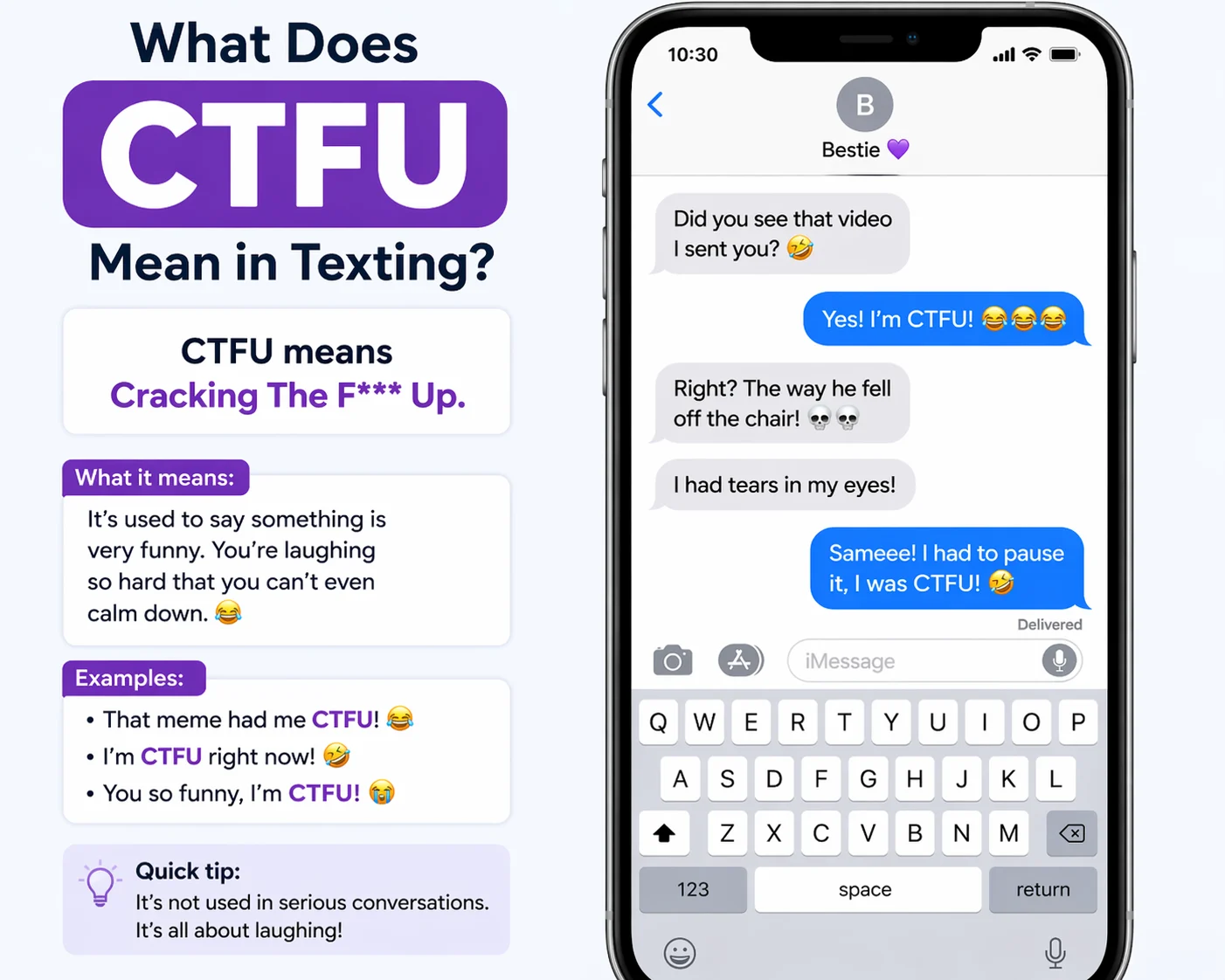
If you’ve ever been scrolling through messages, TikTok comments, or group chats and suddenly saw someone reply with “CTFU”, you’re not alone in wondering what it means.
At first glance, it looks confusing—almost like a typo. But in reality, it’s one of those internet slang terms that people use when something is really funny.
And here’s the thing: slang like this evolves fast. If you don’t keep up, it can feel like everyone else is speaking a different language.
So let’s break it down in the simplest, most real way possible—no fluff, no complicated explanations.
What Does CTFU Mean in Text?
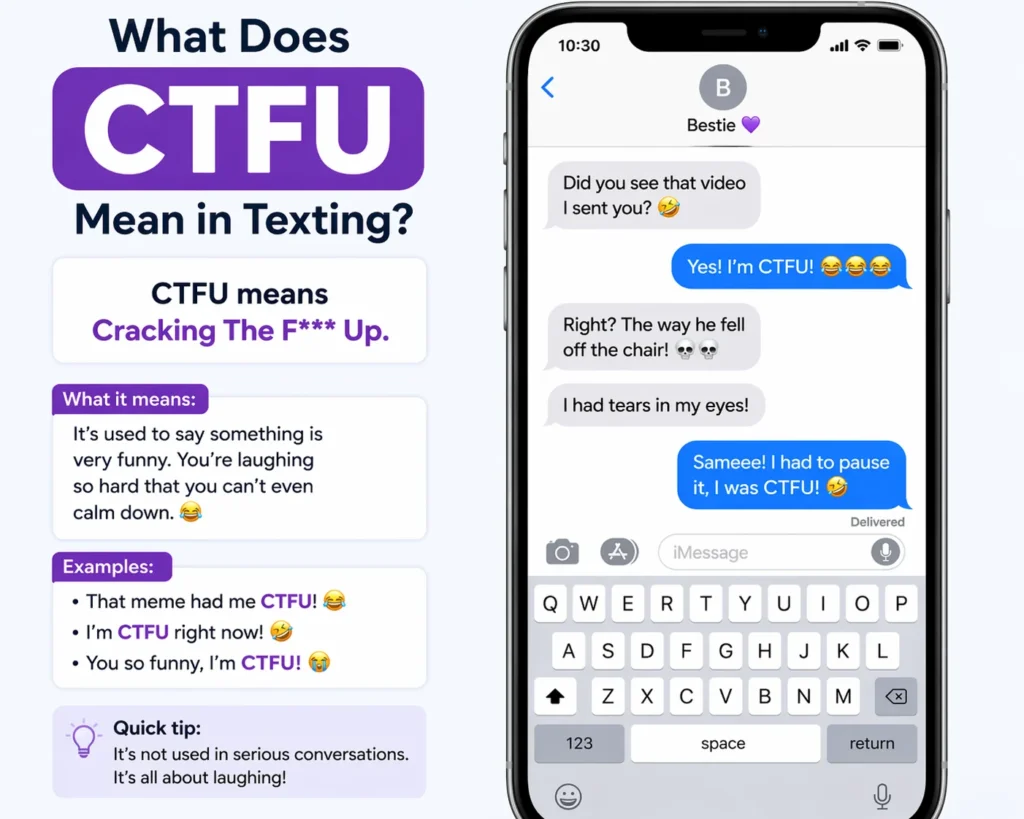
CTFU stands for:
👉 “Cracking The F* Up”**
It’s basically a stronger, more intense version of saying:
- “LOL” (laugh out loud)
- “LMAO” (laughing my ass off)
When someone says CTFU, they’re not just amused—they’re laughing hard. Like the kind of laugh where you can’t breathe for a second.
Simple Meaning:
CTFU = Something is extremely funny
Where Did CTFU Come From?
CTFU comes from urban internet slang, especially from texting culture and social media platforms.
It became popular in:
- Twitter replies
- Instagram comments
- Snapchat and WhatsApp chats
- Meme culture
Over time, people started using it as a quick way to show strong laughter without typing a full sentence.
It’s part of a bigger trend where people shorten phrases to save time—but still express emotion clearly.
How People Use CTFU in Real Life
Let’s make this practical.
Here’s how CTFU actually shows up in conversations:
Example 1 (Texting)
Friend: “I waved back at someone who wasn’t waving at me 😭”
You: “CTFU that’s so embarrassing”
👉 Meaning: You find it really funny.
Example 2 (Social Media Comment)
“Bro fell off the chair mid-video 💀 CTFU”
👉 Meaning: The video was hilarious.
Example 3 (Group Chat)
“That joke caught me off guard… I’m CTFU right now”
👉 Meaning: You’re laughing hard in that moment.
When Should You Use CTFU?
CTFU works best in casual, informal situations.
Use it when:
- You’re texting friends
- You’re reacting to memes
- You’re commenting on funny videos
- You’re joking around
Avoid using it in:
- Professional emails
- Work chats
- Formal conversations
It’s slang—so keep it where it belongs.
CTFU vs LOL vs LMAO (What’s the Difference?)
These all mean laughter—but the intensity is different.
- LOL → Light laugh (polite or mild)
- LMAO → Strong laugh
- CTFU → Very strong, almost uncontrollable laughter
Think of it like this:
👉 LOL = “haha”
👉 LMAO = “that’s really funny”
👉 CTFU = “I’m actually dying laughing right now”
Why People Use CTFU Instead of Full Sentences
Let’s be real—nobody wants to type long reactions anymore.
Instead of writing:
“That was one of the funniest things I’ve seen today”
People just say:
👉 “CTFU”
It’s:
- Faster
- More expressive
- Feels natural in online conversations
Also, slang creates a sense of belonging. When you use it, you feel part of the same digital culture.
Is CTFU Rude or Offensive?
Good question—and the honest answer is:
👉 It depends on the context
Since it includes a censored swear word (“f***”), it can feel:
- Funny among friends
- Slightly inappropriate in formal settings
Safe Rule:
- Use it casually with people you’re comfortable with
- Avoid it where professionalism matters
Emotional Meaning Behind CTFU
CTFU isn’t just about laughing.
It shows:
- Genuine reaction
- Unfiltered emotion
- Spontaneity
When someone uses it, they’re not trying to sound formal—they’re reacting in the moment.
It feels more real than a simple “haha.”
Common Variations of CTFU
People often tweak slang to match their style.
You might see:
- “I’m CTFU rn” → laughing right now
- “CTFU bro 😭” → super funny moment
- “Dead CTFU” → extremely funny
These variations add personality and emotion.
What Does It Mean If Someone Uses CTFU Often?
If someone uses CTFU a lot, it can tell you a few things:
- They enjoy humor and memes
- They’re expressive in conversations
- They prefer casual communication
It doesn’t mean anything deep—but it does reflect their communication style.
CTFU in Social Media Culture
On platforms like TikTok or Instagram, attention spans are short.
So reactions need to be:
- Quick
- Strong
- Easy to understand
That’s why slang like CTFU works so well.
Instead of writing paragraphs, people drop one word—and everyone instantly gets it.
Real-Life Scenario
Imagine this:
You’re watching a video where someone tries to act cool… and then slips and falls.
Your friend sends it to you.
You reply:
👉 “CTFU I wasn’t ready for that 💀”
That one line says everything:
- You laughed hard
- It surprised you
- You enjoyed the moment
No long explanation needed.
Common Mistakes People Make
1. Using It in Serious Situations
If someone shares something emotional, replying with “CTFU” would be inappropriate.
2. Overusing It
If you say it for everything, it loses meaning.
3. Using It Professionally
Not a good idea in emails or workplace chats.
Quick Summary (Featured Snippet Style)
CTFU means “Cracking The F* Up.”**
It’s used in texting and social media to show that something is extremely funny. It’s stronger than LOL or LMAO and is best used in casual conversations.
FAQs
1. What does CTFU stand for?
It stands for “Cracking The F*** Up,” meaning something is very funny.
2. Is CTFU the same as LOL?
No. CTFU shows stronger laughter than LOL.
3. Can I use CTFU in formal messages?
No, it’s best for casual conversations only.
4. Why do people use CTFU?
Because it’s quick, expressive, and shows a strong reaction.
5. Is CTFU popular?
Yes, especially on social media and texting platforms.
Final Thoughts
Slang like CTFU might seem confusing at first—but once you understand it, it actually makes communication more fun and expressive.
It’s not just about saving time. It’s about capturing real emotion in a fast-moving digital world.
And honestly, sometimes a simple “CTFU” says more than a full sentence ever could.
descover more post
What Does TBD Mean in Text Real Meaning Examples 2026
What Does GTG Mean in Text Real Meaning Examples 2026
What Does ihht Mean in Text Real Meaning Examples 2026

M. Kiro is a passionate writer who enjoys turning everyday questions into clear and meaningful answers. He focuses on creating helpful, honest, and easy-to-read content for people who just want simple explanations without confusion. His work reflects consistency, hard work, and a deep commitment to helping readers understand things better.